4 steps to social media wellness by Bailey Parnell.

Social media wellness is a choice. Command your mind and fingers to practice a healthy social routine daily. -k

My previous blog post focused on the four stressors of social media that Bailey Parnell talked about in her TED talk. In her speech, she discusses the four steps to social media wellness as well. She states that social media is here to stay and evolve, but the way people make use of it can change in hopes to reduce mental health issues that our own social media practices become responsible for.

Photo by Nathan Lemon from Unsplash
  1. Recognize the problem: “Awareness is critical” (Parnell, 2017). Start by evaluating your social media habits. What is your social presence like? How much time do you spend on social media on a regular basis? How do you react to other people’s content online? Answering some of these questions for yourself will help you understand what your social media habits are like. Once you recognize the problem you are already one step closer to practicing social media wellness.
  2. Audit your social media diet: “The same way we monitor what goes into our mouth, monitor what goes into your head and heart” (Parnell, 2017). Self-awareness of what and how you go about using social media and behaving on social media is crucial to your mental health. Are you constantly checking your social currency on a recent post you posted online? Evaluating your behavior online will help you become self-aware of your habits. That way you are able to monitor what you are consuming, why you are behaving a certain way, and how that can be fixed.
  3. Create a better online experience: Is your self-worth tied up with social media and what you see other people do or post or talk about online? Parnell shares that his friend felt as if his self-worth was tied with social media, particularly how celebrities made him feel. And, he ended up unfollowing the celebrities and more that made him feel unpleasant. Similarly, Parnell felt for her it was the people who knew that made her feel a certain way that made her delete them off of her profile. Recently, I deleted a photographer off of Instagram who is one of the best wedding and creative fashion photographers of Edmonton. Though when I did a shoot with him that he initiated he promised he would return the pictures within a week. It has been a year now and I see him post several times daily online from other recent shoots, but he did not have the courtesy to respond to my numerous messages/calls, therefore, I finally chose to remove him from my social media so, I do not get upset or angry every time something that he posts comes up on my feed. One piece of great advice Parnell offers is that “you do not have to follow your friends online.” Some of our friends, family or peers that we know personally are not the same online. You do not have to follow a friend who posts “50 pictures from the same concert from the same angle” (Parnell, 2017).
  4. Model good behavior: “Social media is a tool and it’s a tool that can be used for good” (Parnell, 2017). Treat others with respect and how they deserve to be treated online as well as in person. “Social can tear you down or it can lift you up” (Parnell, 2017). The choice is yours!
Picture by Ashley from Unsplash

Social media does not have to hurt your mental health (Parnell, 2017). Make your social media experience by using it wisely and in a healthy manner.

Source: Talks, T. (2017, June 22). Retrieved February 27, 2019, from https://www.youtube.com/watch?v=Czg_9C7gw0o

“What we are really talking about is the dark side of the people, not social media.” -Bailey Parnell

The tool is not to be blamed when the users are responsible for its usage. -k

Social media is merely a tool but the way humans make use of it results in major drawbacks. In Bailey Parnell’s TED talk, she speaks about the four common stressors on social media that become the reason for people’s unpleasant online experiences.

Photo by Eaters Collective from Unsplash

1.Highlight reel: Social media is our highlight reel where we share all the best and positive parts of our lives. But when we come across someone else’s highlights online, we compare our “behind-the-scenes with [their] highlight reel” (Parnell, 2017). That leads to unhappiness and dissatisfaction. After you compare yourself with someone else’s social media presence the process gets worse. You now wait for a perfect time to post the best picture of yourself that you expect to do well in comparison to others’.

Photo by Marc Schäfer from Unsplash

2. Social currency: Parnell refers to social currency as likes, comments, and shares online. The process of “attributing value to something” is called the “economy of attention” in the marketing field, which is similar to how our behavior towards social media work (Parnell, 2017). When we post something on social media we are currently seeking for attention, particularly, the social currency. We base our self-worth on the quantity of social currency we receive from others online. Then, we compare that with other people’s social currency and yet again weigh our self-worth based on other people’s performance online.

Photo by Thought Catalog from Unsplash

3. Fear of missing out: “It is actual social anxiety from the fear that you are missing a potential connection, event or opportunity” (Parnell, 2017). According to collective research conducted by multiple Canadian universities, “7/10 students would get rid of their social networking accounts were it not for fear of being left “out of the loop” (Parnell, 2017).

Photo by Samantha Sophia from Unsplash

4. Online harassment: Most people that are active online are victims or witnesses of online harassment. Parnell shares the statistics where “40% of adults have experienced online harassment [compared to the] 73% who have witnessed online harassment.”

Social media users must understand that the tool is not at fault. People who use this tool in an unhealthy or immature manner are at fault. If not all, most of us go through these four stressors mentioned above. The solutions will be discussed in the following blog post.

Source: Talks, T. (2017, June 22). Retrieved February 27, 2019, from https://www.youtube.com/watch?v=Czg_9C7gw0o

Is LinkedIn a credible social networking site compared to other platforms?

You can find professional connections and work opportunities on any social media platform if you use it in a professional as well as in an honest manner. You don’t particularly need a LinkedIn account for that. -k

From Pexels

At ‘Career Speakers Networking Event: Spark Conversations, Blaze a Trail’ organized by the Faculty of Bachelors of Communications, I heard a speaker talk about the importance of having a social presence on LinkedIn. The speakers at this event were either professionals in their fields or students who had enough knowledge about the mass media industry. They shared stories about how they established their brands in the mass media world as well as shared tips and tricks finding work opportunities. One of the speakers suggested creating a LinkedIn account, in particular, to find work opportunities. Benefits of having a LinkedIn profile were also discussed such as being able to find useful connections, work opportunities and meaningful knowledge about the labor market. I disagree that a LinkedIn profile is to find work, connections or showcase your professionalism.

“LinkedIn is a social networking site dedicated to making business connections for the purposes of building a professional network and sharing employment opportunities” (Edwards et al, 2015). It “provides information about a user that viewers can use to make judgments about the source, such as their credibility and attractiveness” (Edwards, 2015). However, viewers are able to judge one’s personality, credibility and attractiveness by viewing their pictures on other platforms as well. One’s English abilities can also be judged by evaluating their captions or tweets. Examining hashtags that are attached to one’s post can also be used to judge a person or their content. Employers have enough at their disposal about a person to judge by evaluating the content one posts on other social media platforms like Instagram, Twitter or Facebook.

LinkedIn is believed to be different from other platforms because it launched with a mission to allow people make business connections with a purpose of establishing large, professional networks and sharing employment opportunities (Edwards et al, 2015). When LinkedIn users post a profile picture on their profiles, they are perceived as more socially attractive and more competent than users who do not post a picture (Edwards et al, 2015). Social attractiveness and competence of one can be judged from numerous pictures a person post on IG or FB as well. With that being said, what is it that makes LinkedIn a unique platform for one to use in order to find work opportunities?

Most speakers and peers at the ‘Career Speakers Networking Event: Spark Conversations, Blaze a Trail’ believed that LinkedIn is a credible platform that helps a person find filtered credible connections. Edwards et al (2015) in a report mentioned that LinkedIn indeed is “positioned as a network built for professions and its members rely heavily on the sites ability to make users seem credible.” However, recent research says “despite the significant role source credibility plays in the success of this social networking sites, LinkedIn has largely escaped the scope of current research literature and how users manage self-image and perceive other users” (Edwards et al, 2015). Within this rather large research gap, Bohnert and Ross have investigated the effects of social networking sites on an evaluation of job candidates (Edwards et al, 2015). Bohnert and Ross “examined the role of profile orientation, finding that applicants with either a family-oriented or a professional-oriented social networking profile were seen as more fit and reliable for the job compared to those with profiles oriented toward activities such as drinking alcohol as well as those who had no discernible orientation due to a lack of available cues and information” (Edwards et al, 2015).

According to research based on Sandar’s MAIN model, results prove that having a profile picture on a LinkedIn account can be used to judge credibility. You must be wondering how? Edwards et al (2015) explain that this feature is problematic because “it stands in contrast to traditional means of initial employee evaluations, the résumé, which does not typically include a picture of the individual applying for a position.” In contrast, recent studies say that a “profile picture add a sense of the presence of those who are not physically present and how viewers of profiles use these cues to determine credibility and attractiveness” (Edwards et al, 2015). As a conclusion, adding a profile picture on a LinkedIn profile conveys social presence which adds to the credibility factor of a person. Moreover, social presence directly confirms that the “individual has importance, believability, and is knowledgeable” (Edwards et al, 2015).

Photo by Marc Schäfer from Unsplash

These pieces of information from researchers such as Bohnert and Ross conclude that there is a way to predict one’s credibility on LinkedIn like other social networking sites. Though “with individuals able to entirely manipulate the profile’s information in order to present themselves as competent, likeable, and knowledgeable, it may be difficult for other members, particularly recruiters and ‘connections’, to objectively ascertain what is true, an exaggeration of truth, or an outright falsification” (Edwards et al, 2015). How can one tell if a person is not stealing someone else’s image from the internet to post it as their profile picture on their LinkedIn profile? This raises a question of concern as well add to the difficulties an employer may come across when using LinkedIn as a means of finding and critiquing potential candidates. “Legal considerations such as negligent hiring, information inaccuracy, privacy, and justice need to be taken into consideration and may pose a threat to a company if it is believed that a social networking website was wrongfully used to judge a potential job candidate” (Edwards et al, 2015).

Source:

Edwards, C., Stoll, B., Faculak, N., & Karman, S. (2015, October 15). Social Presence on LinkedIn: Perceived Credibility and Interpersonal Attractiveness Based on User Profile Picture. Retrieved from https://www.ojcmt.net/article/social-presence-on-linkedin-perceived-credibility-and-interpersonal-attractiveness-based-on-user

Save Your Brain: Zombie Scrolling Syndrome and Social Media

by Emily Kaye

Do you spend hours on scrolling on social media before realizing that you haven’t read a post in the past few minutes, and the daylight has disappeared? Do friends and family members roll their eyes when you absently reach for your phone in the middle of a conversation? Have you ever opened your phone only to tap around pointlessly, opening and closing apps out of habit, and are left wondering why you picked up your phone in the first place?

If you have answered yes to one or more of these questions, you might have Zombie Scrolling Syndrome.

Photo by Nathan Wright on Unsplash

Zombie Scrolling Syndrome (ZSS), a term coined by the McAfee security company in 2016, is “mindless scrolling out of habit with no real destination or benefit” (Birdsong, 2016).

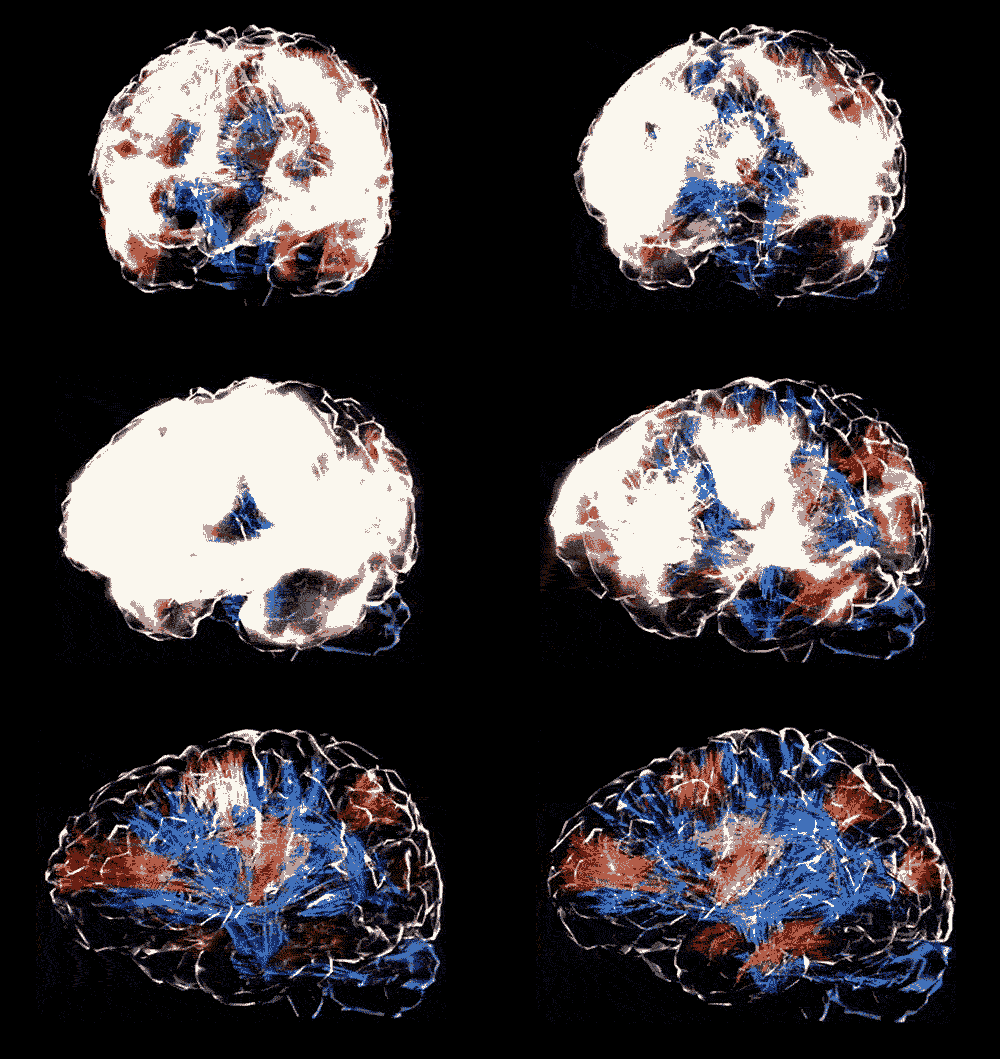
According to Wired, our brain lights up like a Christmas tree when we receive likes and positive feedback on social media, this is due to a release of dopamine, a neurotransmitter that is normally associated with the pleasure centre of the brain (Simon, 2018). Coincidentally, this is the same area of the brain that activates with addicts and alcoholics, which supports the belief that social media can become an addition (Simon, 2018).

University of California via Giphy

Technology companies are beginning to address this phenomenon by installing new software, such as Apple’s screen time tracker, to help make users aware of how much time they are spending scrolling their lives away.

Social media platforms, such as Instagram, are also adding new features to notify scrollers when they’ve seen everything posted within the past few days.

Detailed Activity Reports show the total time spent in each app, usage across categories of apps, how many notifications are received and how often a person picks up their iOS device. retrieved from Apple.com

These additions may help raise people’s awareness of how much time we spend looking at, well, nothing, but at the end of the day a notification telling you that you have spent 5 hours on social media that day can be just as easily ignored as the notification asking you to back up your phone for the umpteenth time.

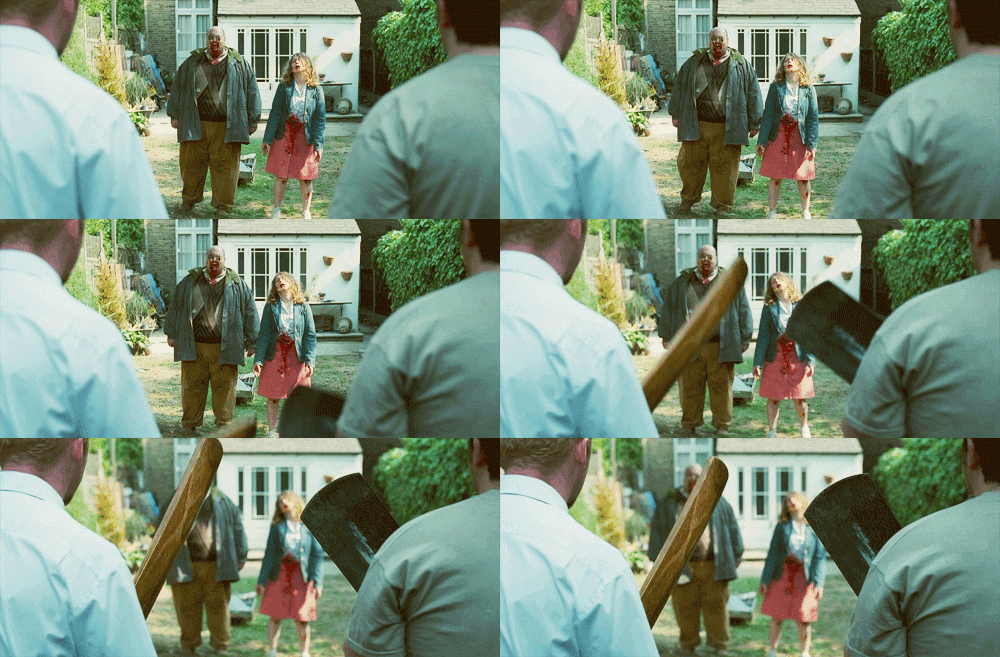
Ultimately, the choice is yours. Will you choose to scroll yourself into Zombie-hood or will you put down the device and save your brain?

Shaun of the Dead (2004) via Giphy

Sources:

Birdsong, T. (2016). Is Zombie Scrolling Syndrome Zapping Your Child’s Health? | McAfee Blogs. Retrieved from https://securingtomorrow.mcafee.com/consumer/family-safety/zombie-scrolling-syndrome-zapping-childs-health/

Simon, M. (2018). Learn From These Bugs. Don’t Let Social Media Zombify You. Retrieved from https://www.wired.com/story/learn-from-these-bugs-dont-let-social-media-zombify-you/

Studio Canal. (2004). Shaun of the Dead [Video]. Ealing Studios, London UK.

University of California. Brain Neuroscience Gif [Video]. Retrieved from https://giphy.com/gifs/brain-neuroscience-visualization-l41lJ8ywG1ncm9FXW/links

A discussion about #hashtags.

If used properly, hashtags can become the most powerful organic method of increasing your brand’s visibility beyond your followers on Instagram. -k

Photo by Elena Koycheva from Unsplash

“Hashtags are tags or words prepended with ‘#’ used to indicate the content of the picture, allowing users to search for pictures and increase visibility” (Anonymous, 2016). Hashtags help social media users establish their brand culture on platforms such as Instagram and Twitter. The role of hashtags is crucially evolving as they add to one’s social media profiles interest scale. By adding a hashtag with a post on platforms like Instagram, one is able to categorize as well as “retrieve visual content” for the audience in a systematic way (Anonymous, 2016 ).

Why should you use hashtags on social media platforms such as Instagram?

  1. To establish a community that will revolve around your brand.
  2. To make it easier for your social profile/brand to be found online.
  3. To allow one to increase his or her brand’s presence online.
  4. Hashtags allow one’s  brand or message to travel beyond their followers on platforms such as Instagram.
  5. A larger audience is bound to result through the use of hashtags that revolve around a trending topic.

What makes hashtags the most compatible with Instagram?

While using normal hashtags with words were already in trend, Instagram made it easier for emotions to travel with images and videos through the use of emoticons, which takes the hashtag evolution to a step further. “In January 2011 Instagram added hashtags and from 27 April 2015 users [were] able to use emoji as hashtags” (Anonymous, 2016). Recently a new feature has also been added to Instagram that allows Instagrammers to follow hashtags like they would follow people’s profiles. Anything and everything that gets published on Instagram with that particular hashtag will pop on one’s personal feed. These two unique features make Instagram one of the best platform that is compatible with hashtags.

How hashtags can be used properly on Instagram?

“A basic role of hashtags was traditionally to organize knowledge and facilitate access and enable retrieval of information” (Giannoulakis & Tsapatsoulis, 2016).  However, users “extend the function of hashtagging beyond findability and give hashtags a metacommunicative use” (Anonymous, 2016). “According to Daer et al.  [15] the metacommunicative function can be split into four codes: ‘emphasizing’, ‘iterating’, ‘critiquing’, ‘identifying’, and ‘rallying’. ‘Emphasizing’ is used to give emphasis or call attention; ‘critiquing’ expresses judgment or verdict; ‘identifying’ is used to refer to the author of the post; ‘iterating’ to expresses humor and ‘rallying’ brings awareness or support to a cause” (Anonymous, 2016). The best practice is to use words as hashtags that actually describe the content of a post. “In a research on the tags of a set of 2700 pictures, it was measured that approximately 10% of these photos were related with emotion words not directly related with their visual content” (Anonymous, 2016). Using appropriate emotions that directly relate to the emotions with the visual content of the image may also help a post to do well in terms of visibility beyond followers.

Source: Evaluating the descriptive power of Instagram hashtags. (2016, November 11). Retrieved fromhttps://www.sciencedirect.com/science/article/pii/S2352664516300141

Fat: The other ‘F Word’

by Theodora MacLeod

It started with a book by Lindy West, published in 2016 a manifesto for all the fat girls living in a world that demands we take up less space. In 2019, the series came to Hulu. Six episodes of Aidy Bryant on a journey to self-acceptance that comes with enough power to inspire a new generation of women into loving themselves. That might just be the power of “Shrill.”

@Plussizebarbieofficial on Instagram


The fat acceptance movement has been a thing since the mid-to-late 1960s and centres around body acceptance and the idea that there is nothing wrong with being fat. It shouldn’t be a revolutionary idea, but as the popularity of “Shrill” shows us, it’s still new in the eyes of the viewer. To see a fat character behave as more than a stereotype is refreshing, it’s something that is seldom seen in television or films.

The body acceptance movement has seen a resurgence in the last decade as fat people are no longer standing by as the punchline of an over told joke. It is thanks to platforms like Instagram and Tumblr that these activists have a voice.

As a plus size woman, a person of size, a fat chick, or whatever you want to call me, I can’t explain the joy that watching “Shrill” and seeing posts from people who look like me, has given me. It’s hard to explain what being underrepresented or misrepresented in the media feels like unless you’ve experienced it. When everyday it feels like you’re invisible, it’s a breath of fresh air to see other people like you thriving.

@FatGirlFlow on Instagram

Beauty vloggers like Edmonton’s own Lyndsay Patricia (@PlusSizeBarbieOfficial) are giving a voice to the women and girls who have been silent for so long, shopping in the back corners of stores and tugging on their sweaters to hide what they see as flaws. We shrink into the background, hoping not to draw attention to the bodies that have done so much for us but don’t fit the ideal. Women like Corissa Enneking (@FatGirlFlow) are making the statement we can be happy no matter our size, and that beauty shouldn’t be based on size.

The resurgence of fat positivity isn’t just a movement, it’s a call to arms, a battle cry for all the heartbroken girls struggling to find fashion that fits them. It’s a reminder that beauty is more than size, and fat women aren’t your punchline.

This is Terrible… Keep Going: My Favourite Murder

On January 16th 2016, two women –Karen and Georgia– came together to publish their first podcast. It was done in a living room, just two gals chatting about their favourite topic: murder.

After meeting at a party and realizing they were both true crime fans, Karen Kilgariff and Georgia Hardstark started what would become a true crime revolution. To date they have put out 286 episodes, including live shows, and what they call “minisodes”– which feature the hometown murders of listeners. They’ve sold out hundreds of shows all over the world, and have developed a cult following of “murderinos” who find their kicks learning about true crime among other things.

A 2010 study found that women, more than men are fascinated by true crime, and suggests that “women fear becoming the victims of a crime more so than do men.” The study further claims that women feel they can learn tricks of survival by studying true crime.

Once upon a time they had a facebook page which invited true crime fanatics and podcast fans to come together in harmony, but like all good things on the internet, it turned into a dumpster fire and had to be shut down. Fortunately however, it lead to a number of spin off groups of some of the sweetest people I’ve ever met. From Meowderinos– a page for cat lovers, to You’re in a Cult Call Squirrely Dan– a group for fans of the show Letterkenny. While no one has an official count, there are easily hundreds of different facebook groups that combine true crime with other interests. For the most part, the community operates by the basic rules of kindness, and seldom is there an issue with members.

Source Unknown taken from Pinterest

With their own jargon and phrases like “Fuck Politeness,” “You’re in a cult, call your dad,” and “Stay sexy, don’t get murdered,” they have created a crafter’s dream and a merch sellers paradise with hundreds of Etsy shops featuring unique My Favourite Murder merchandise. But what My Favourite Murder has created is more than a simple hilarious podcast about murder, it’s a community of like-minded people who can come together to share, create, and help each other. I know that if I have a rough day, there are weirdos all over the world who will send me pictures of their cats, if there’s a big development on a cold case, we’ll be the first to spread the news, but most of all, I know that I’m not alone in my interests, anxieties and passions because even though it’s a big scary internet out there, there’s a corner of it made for people like me.

Vicary, A. M., & Fraley, R. C. (2010). Captured by True Crime: Why Are Women Drawn to Tales of Rape, Murder, and Serial Killers? Social Psychological and Personality Science,1(1), 81-86. doi:10.1177/1948550609355486

A discussion about spoken news and its major advantages.

Spoken news has been proven to be effective as it allows people to communicate with ease. -k

Photo by Kyle Glenn from Unsplash

What medium is the most powerful when it comes to delivering news or sharing ideas with one another? The culture of communication and technology, which is used for communication has grown immensely from spoken news to print media to electronic news. The medium that is used to communicate is as important as the message that is being delivered (Alder et al., 2015, p.16). With that being said it is crucial to be selective while choosing a medium to share or consume news. While most people attempt to hide behind a screen to connect and communicate with others, spoken news is slowly dying. Spoken news includes the news we consume from television. To add, word of mouth also falls under spoken news. This form of communication allows people to communicate face to face, which lets people pick up on small details of the message by looking at one’s gestures, expressions, and body language.

As someone who grew up in a joint family, spoken news was the primary method of consuming and sharing the news. Humans have relied on using spoken news as a method of communication for years with rare exceptions because of its benefits (Stephens, 1999). Spoken news was a means to keep the family connected. My grandfather served in the army for 40 years and some of the finest memories I have with him are the ones where he used to share stories and his experiences as an army veteran.

A piece of news that had a significant impact on my life was one of the Tsunamis of 2005. If I may recall, my grandfather was the first person who informed me about the tragedy. Later, I was informed about it at school as my school decided to out a grand prize in place for the student who could fundraise the most amount of money to help the ones in need. The news of Tsunamis spread rapidly in my community via word of mouth. I prefer spoken news as my method of communication because face-to-face communication allows for the highest amount of information to be conveyed (Alder et al., 2015, p. 16).

Spoken news can be distorted as it gets circulated from one person to another, but the same can happen to news as it travels from one social media platform to another. However, my experience still makes me argue that spoken news can be fun especially when you start with “hey, did you hear about the national emergency alert in America?”

Sources:

Adler, Ronald B. et al (2015). Language, Understanding Human Communication (pp. 114-115) Oxford

Stephens, Mitchell. Nov/Dec99. From the Time of the Dragon, The Constancy of            News, Vol.38 (4), p.66.http://content.ebscohost.com.ezproxy.macewan.ca/ContentServer.asp?EbscoContent=dGJyMNLr40SeqLU4y9fwOLCmr1Cep7NSs6y4SK6WxWXS&ContentCustomer=dGJyMPGqt0uyrLVRuePfgeyx43zx1%2B6B&T=P&P=AN&S=R&D=ufh&K=2456334


A Life Online: Children and Social Media

by Theodora MacLeod

When it comes to their children, there’s nothing most parents wouldn’t do. From overpriced preschools to professional photoshoots, many children are living the high life before they can even spell those words. But when it comes to privacy, some parents are missing the mark. There isn’t a parent alive who doesn’t love to brag about their child, and Facebook or Instagram can seem like the perfect place to share their joy, but at what point does the child’s consent come into play.

Picture from Publicdomainpictures.net


I’m not talking about consent like the propaganda about needing consent to change a diaper, what I’m referring to more is at what point does the child have a say in their digital footprint. According to a 2010 study: “Almost a quarter (23%) of children begin their digital lives when parents upload their prenatal sonogram scans to the Internet. This figure is higher in the US, where 34 percent have posted sonograms online, while in Canada the figure is even higher at 37 percent.” By the age of two the number of children with a digital presence spikes to 92 percent in the U.S and 84 percent in Canada. That’s almost every single child having a presence on the internet before they can understand what the internet really is.

I’m not saying there’s anything wrong with posting a picture of little Johnny Jr. on your instagram, or snapping a cute video of Sally in her tutu and uploading it for the grandparents. But there comes a point when too much is too much. For example, the trend of starting an instagram for a youngster before they’re even born can lead to all kinds of issues, from unwanted attention (there are some scary people out there,) to the reality that maybe your child won’t want their baby pics to pop up when an employer searches them in the future.

Instagram of BabyLuyendyk, unborn child of Bachelor stars.


This trend is especially common amongst celebrities and wannabe celebs; from the unborn child of Bachelor star Arie Luyendyk Jr. to Serena Williams’ little lady. Sure, who doesn’t like looking at pictures of cute celebrity babies, but when it comes to their autonomy in the future and privacy, I’m siding  with stars like Andy Samberg and Joanna Newsom, who have yet to even release the name of their toddler, let alone an image.

Digital Birth: Welcome to the Online World. (2010, October 06). Retrieved from https://www.businesswire.com/news/home/20101006006722/en/Digital-Birth-Online-World

How should local NGOs begin experimenting with social media: Clay Shirky’s advice.

You do not master the art of social media overnight. The best way is to explore, learn and implement. -k

Social media is an integral part of the works of establishing one’s brand in a short amount of time compared to traditional media or spoken word. “The power of social media is transforming the way in which non-profits accomplish their missions” (Administrator, 2009). “Traditional methods such as fundraising and advocacy will directly benefit from the availability of a wide range of affordable online services and applicants” (Administrator, 2009).  When it comes to local nonprofit organizations, “the uptake is limited and in most cases not part of a broader strategic approach” (Administrator, 2009).

Photo by NordWood Themes from Unsplash

To discuss such technology-based issues and solutions, annual conferences are organized by Nonprofit Technology Enterprise Network (NTEN) around the world. NTEN is an organization of nonprofit technology professionals that help other nonprofit organizations use all aspects of technology effectively and efficiently. In the Nonprofit Technology Conference (NTC) organized by NTEN in the USA in 2009, the author of Here Comes Everybody: The Power of Organizing Without Organizations, Clay Shirky discussed that nonprofit organizations will require a strategy to make use of social media and what the internet has to offer to their existing operating model. In his presentation during the conference, he stated that “online social media is here to stay and it is both powerful and scary” because “by embracing social media, [an organization’s] members and supporters will be able to talk to one another without you” (Administrator, 2009). As discussed in BCSC 202, strategic planning is the most crucial factor for any brand to take off online.

Shirky believes that “while it may take a redesign of an organization’s operating model to truly make it worthwhile; do not be afraid to give [social media] a try” (Administrator, 2009). In order to raise funds and receive support from people around the community, NGOs do need to be able to harness social media. During that process, the most common question is –  how should a local organization begin to explore with social media to its advantage in an effective manner?

To answer that question, Shirky uses Twitter (@cshirky).

  1. “fail informatively, don’t spend more time talking about its potential than it would take to just try it in the first place.”
  2. “poll your constituents; they’re already on Facebook.”
  3. “don’t hire a consultant; speak to your own 23-year-old in your organization”
  4. “find that person in your organization with the one big idea and get her out of the room until she comes back with 50 medium-sized ones”
  5. “to get to a large and good system, start with a small and good system”
Photo by Priscilla Du Preez from Unsplash

To reiterate, local NGOs should train their own team members to use social media. Using social media on its own will allow the organization to build a personal connection with its community. This will ensure stories to be created with an emotional touch that will increase engagement and interaction online. A strategy along the run will help the team have a clear vision and stay true to their purpose.

Sources: Administrator. (2009, May 20). NGOs and Social Media – Challenges and Opportunities. Retrieved from http://www.ngopulse.org/article/ngos-and-social-media-challenges-and-opportunities

Define your goals & needs with Tech Accelerate. (n.d.). Retrieved from https://www.nten.org/